A Letter to the Diaspora Investor Considering Land in Lagos
April 27, 2026


If you are reading this, chances are land in Lagos has crossed your mind more than once.
Maybe it started as a passing thought, something to do “one day.” Maybe it shows up every time you send money home, every time a friend mentions a new estate, or every time you hear what something you once ignored now costs. Or maybe it’s a quieter concern: the feeling that Lagos is moving, and you’re not yet fully positioned.
This is not written to persuade you to buy immediately. It is written to help you see Lagos land the way it actually behaves over time, at scale, and from a distance. Because the real risk is not that you buy land in Lagos and make a mistake. It is that you wait too long, and the decision slowly disappears.
The Unspoken Anxiety of Watching From Afar
Most people living abroad won’t say this openly, but it sits underneath many conversations: the fear of becoming priced out of relevance. Not just priced out of locations, but priced out of opportunity.
What unsettles people is not fraud stories alone. It is watching places that once felt optional become unreachable. It is realizing that what once required foresight now requires far more capital, far more compromise, and far less flexibility. Lagos has an uncomfortable habit of making yesterday’s hesitation expensive.
Lagos Does Not Grow Linearly
Lagos does not creep forward. It accelerates. Population pressure, infrastructure rollouts, commercial migration, and policy decisions don’t spread value evenly. They compress it into corridors. And when those corridors activate, land does not politely appreciate. It resets to a new level.
This is why Lagos land rarely feels cheaper later. By the time certainty arrives, access is already restricted.
The Ibeju-Lekki Reset: Where the Future is Being Built
There was a time when large parts of the Lekki axis were dismissed as distant or speculative. Not because they lacked potential, but because the city hadn’t arrived yet. Today, we are watching a “city within a city” emerge in Ibeju-Lekki, and the gravity of Lagos is shifting permanently.
In the early 2010s, plots in Ibeju-Lekki were often treated as farmland with a Lagos address. Prices sat below ₦2 million. Many passed, convinced it was too early. But Lagos has arrived, and it has brought billions of dollars in infrastructure with it.
We are looking at a convergence of projects that are fundamentally repricing the region in real-time:
When you combine these with the Lekki Free Trade Zone, you aren’t just looking at land appreciation. You are looking at a massive value reset. Those same plots that were ₦2 million a decade ago are now valued at ₦25 to ₦40 million and above. And with the coastal road and refinery coming online, the next few years represent a very narrow window before the next major price jump.
What These Shifts Are Quietly Telling You
These examples are not outliers. They are the Lagos blueprint. Land here tends to move through recognizable stages: it is ignored, then questioned, then activated, and finally repriced beyond casual reach. Once a location completes that cycle, it rarely returns to the earlier conversation.
Lekki Phase 1 went through this in the mid-2000s when ₦15 million felt like a lot. Today, those plots are ₦500 million. Eko Atlantic moved from ₦200 million allocations to ₦2 billion prime plots in a decade.
Investors often wait for clarity, only to discover that clarity is expensive.
Why Waiting Is Not Neutral
From abroad, land ownership can feel deceptively simple because money moves faster than context. But distance introduces subtle risks: decisions based on incomplete signals, or reliance on representatives who don’t share your exposure. Many people technically own land in Lagos but struggle to control it, to resell it, or to leverage it without being physically present.
There is a comforting idea that one can simply wait and buy later. In Lagos, waiting is rarely neutral. As time passes, entry prices rise, flexible inventory shrinks, and errors become costlier. What once required strategy begins to require sacrifice.
People with long exposure to this market tend to converge on the same conclusion: Owning one plot solves curiosity. Owning enough solves positioning. Land becomes more than an asset. It hedges currency risk, it anchors long-term plans, and it preserves your optionality. The urgency is not driven by greed; it is driven by the realization that scarcity compounds faster than income does.
Why DK Homes Is Part of This Conversation
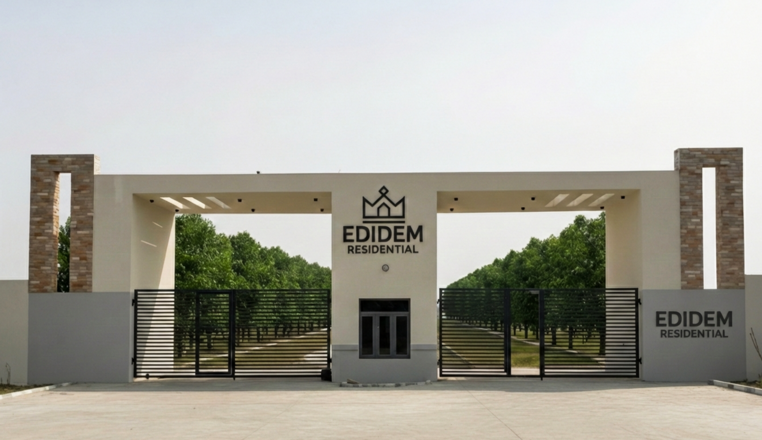
DK Homes exists because Lagos land has outgrown casual decision-making. Our role is not to push inventory. It is to help you think clearly about positioning legally, structurally, and over time. We focus on understanding where land sits in the growth arc of the city, what it realistically allows, and how it holds up beyond the purchase moment.
We decline more opportunities than we present, because in a market like Lagos, discernment is not optional.
A Closing Thought
Every generation in Lagos looks back at a location they once ignored and says the same thing: “I didn’t think it would get this expensive.”
That sentence has repeated itself for decades. Lagos does not pause. Prices do not soften for hindsight. And access rarely widens. The real decision is not whether to own land in Lagos. It is whether you position early, or eventually pay for certainty.
At DK Homes, we believe clarity should come before commitment. That is where meaningful decisions begin.